Z potrzeby zmiany i znalezienia sposobu, by informować świat o naszych działaniach postanowiliśmy zmienić profil naszego bloga. Nie będziemy tu umieszczać jedynie scenariusz CLILowych i to po angielsku, a zajmiemy się rejestrowaniem co lepszych zajęć w naszej szkole językowej. Będzie to również miejsce, gdzie znajdziecie Państwo gorące informacje o zmianach, jakie planujemy. Pewnie co jakiś czas pojawią się posty po angielsku zawierające scenariusze, nie będą jednak stanowiły większości materiału na blogu.
Po niemal dziesięciu latach wędrówki Rainbow English zna kurs, w jakim zmierza. Wiemy już, którędy płynąć, by czuć się spełnionym. Dokąd dopłyniemy? Sami jesteśmy ciekawi!
In our offer we have lessons for big groups, usually school classes. This time we had a chance to meet wonderful children from a school nearby, aged 10/11, who decided to have a meeting on healthy food. Boring, right? Well with CLIL, with good CLIL, nothing is dull. But that needs loads of preparations, hours of writing & searching through the Internet. This time everything worked well.
The lesson plan is a part of Erasmus+ Project: "Bilingual Education - a step ahead" where we are partners.
TIME: 120 mins
1. We started with a book "The Very Hungry Caterpillar" and a small talk about nutrition. HOTS and LOTS questions appeared as usual to activate children's prior knowledge.
2. I asked Ss to fill in a short questionnaire where different products were listed, both healthy and unhealthy ones. We used their answers to talk more about healthy food and unhealthy habits ;)
3. That was an excellent introduction to a food pyramid that we analysed step by step thinking how many portions a day we should/can consume to stay healthy and strong.
4. I asked Ss to build Food Group trees. A wonderful idea for practising thinking skills.
5. Now some LEGO! Working in groups students constructed food pyramids where they placed little flashcards with food.
Well, some of the pyramids were closer to dreams that healthy, harsh reality ;)
6. The last task - a kind of evaluation - was to build My Plate with representatives of all healthy food groups.
Water, chicken, an orange, a lemon, a piece of watermelon
Some pasta, chicken, tomatoes, lemons and milk
A tomato, some milk, salad, chicken breast and a sandwich
Hot chocolate, green salad, a sandwich, some beetroot soup, a steak
Tomato soup with rice, two sandwiches, some fruit yoghurt, green salad, multivitamin juice
a sandwich, a chicken leg, green salad, milk, an orange
Kids enjoyed the lesson a lot! The feedback was very positive and we are going to meet again soon to have another lesson together!
Our language school has just started realisation of the European Project within Erasmus+ Programme. One of the first topics we focused on was Art.
Two teachers introduced Salvador Dali as this painter was really exceptional and his art is thought provoking.
The poster above was created by one of the teachers as an example how visuals can help understand the topic. If you click Dali's head, you will open a new window with a film on Youtube that we used as an introduction to the topic.
Later, we ask Ss to match key words for surrealism with their definitions.
Afterwards, there was a time for a little game. In lower groups a teacher and in more confident ones - a student, described this picture to the rest of participants:
The Ss were supposed to draw what they are dictated. It was real fun!
The next step was to answer some questions concerning other Dali's famous pictures. This task is time consuming and I propose to leave it to more confident groups.
Homework was creative - as every formative assessment should aim at such - Ss were asked to draw and describe a surreal picture.
I have discovered with great amazement that my teenage students were not familiar with one of the most significant film directors at all! Well, this experience was highly inspiring and in one evening the whole lesson plan was created.
The lesson is divided into two meetings which is crucial for its success.
DAY 1
Prior knowledge
TIME: 10 mins
Ask Ss some questions about American cinematography, Alfred Hitchcock and his films. Activate their prior knowledge, ask about favourite movies, directors etc. Check if they can elicit genres in cinematography and give examples of films and/or describe their features.
TASK 1
TIME: 5/10 mins
Show Ss the mosaic illustrating the most important films by Hitchcock asking them whether their have seen/heard about any of them. In my case, the answer was almost always negative so I spent some time talking about the plot and explaining the symbolism of the posters. With a creative group you can ask them to guess what the films are about.
TASK 2
TIME: 10 mins
Ask Ss what a trailer is, if they could indicate its features. Afterwards, play the video with Alfred Hitchcock inviting the viewers to watch his latest film "Psycho".
After the show ask Ss to compare and contrast this trailer with what they know from cinemas. Another thing to talk about is the person of Alfred Hitchcock and the way he presents the film, the plot and the location.
TASK 3
TIME: 10/15 mins
Tell the Ss that they are going to see famous scenes from two masterpieces - "Psycho" and "the Birds".
If you haven't asked them to make up stories in Task 1, do it now after watching the pieces.
TASK 4
TIME: 10 mins
Give the Ss shuffled texts describing plots of the films. They can be spoilers or incomplete stories to leave some space for suspense ;) I used Wikipedia to prepare mine but the text should be adjusted to the Ss level.
Ask Ss to put the pieces in the correct order. Check it together explaining any new vocabulary. It is essential for the homework!
TASK 5
TIME: 5 mins
If your Ss got interested in Hitchcock's work you can show them a trailer (a good comparison again!) of the biographical film about this director. It's a filmed story of how "Psycho" was produced and starred with Anthony Hopkins, Helen Murren and Scarlett Johanson or Jessica Biel so Ss should be attracted by these names.
HOMEWORK - Be like Alfred Hitchcock!
Ask Ss to prepare an oral presentation of one of Hitchcock's films (can be the ones presented during the lesson) and give a speech where audibility, pronunciation, articulation and vocal expression will be judged.
DAY 2
TASK 1
TIME: 5/10 mins per person
Presentations of students' trailers.
TASK 2
Assessment - ask Ss to evaluate their performances. In this case it was an individual assessment sheet with 1-5 scale.
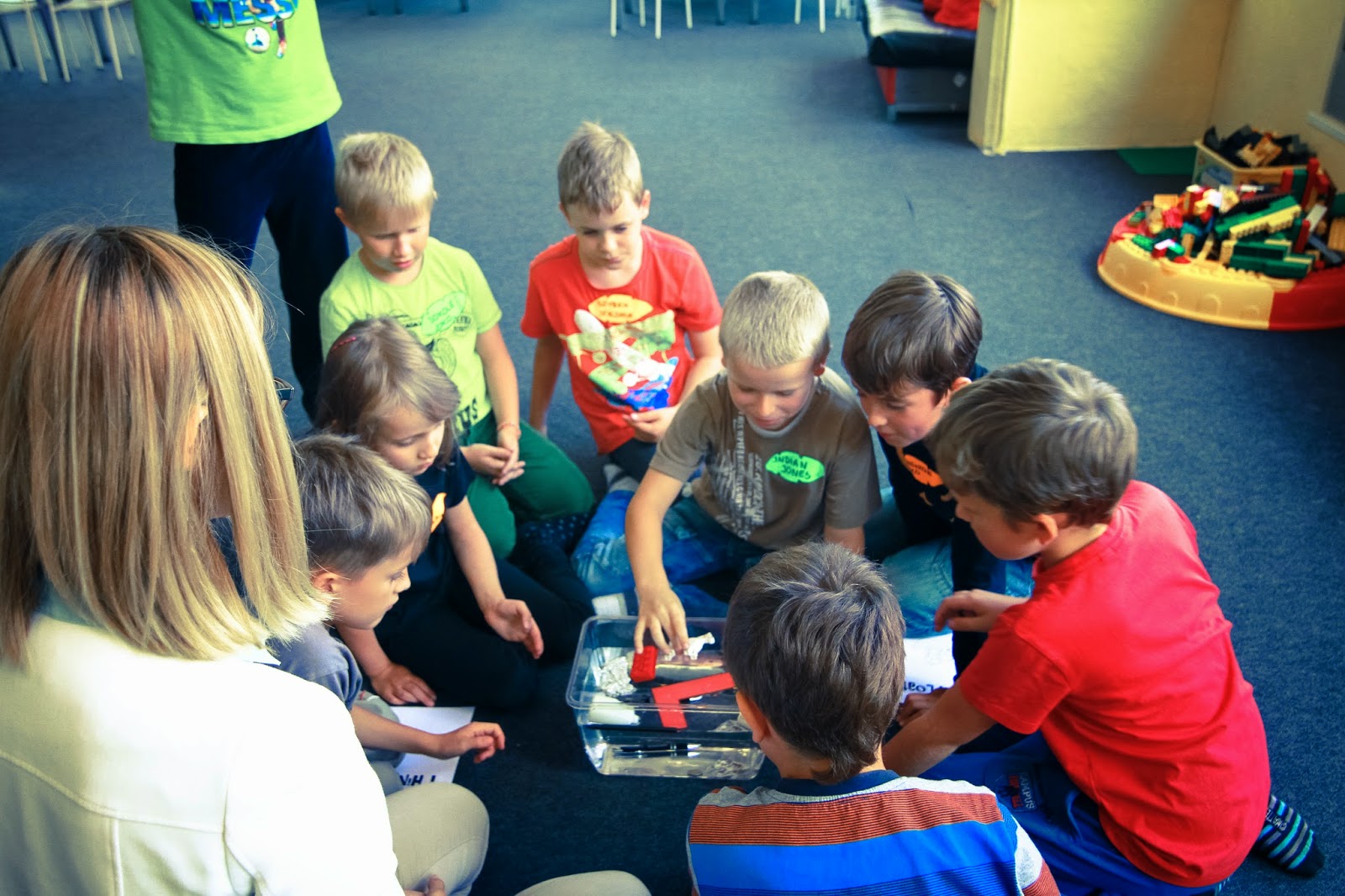
In our lessons we try to combine scientific experiments with some interesting information concerning the world. This time we have decided to familiar kids with an idea of sinking and floating, and tell them a bit about the Dead Sea.
Prior knowledge – Cognition/Communication
TIME: 10 mins
Ask
Ss to walk around the classroom and bring a few objects they might throw
into water. Beforehand, prepare a large, transparent bowl filled with
water.
Ask Ss to classify the objects into two categories - what will float and what will sink in their opinion.
The good idea will be to prepare two big writings or containers where they could place the objects. Ask them to name each of the objects.
TASK 1 – Cognition/Communication/Content
TIME: 10 mins
Ask
Ss to drop the objects one after another into the bowl to observe
whether they float or sink. Ss should now check if their guesses were
correct. If not, they should place the objects on the right side.
TASK 2 - Cognition/Communication/Content
TIME: 2 mins
Tell your students why things float or sink. Below we put a scientific explanation of the phenomenon. Definitely the adjustment to your Ss' level of English will be required.
Things
float or sink because of density. Density is a measure of how much mass
per volume; we use grams (g) per cubic centimetre (cc). Fresh water has
a density of t, that is, 1 gram per cc. If an object has a density less
than 1, it floats. If it has a density greater than 1, if sinks. For
example, iron has a density of 7.8, so it would sink.
TASK 3 - Cognition/Communication/Content
TIME: 10 mins
Add
some salt to the water. Repeat the experiment. Are there any changes?
Notice that the more salt you add, the more objects float. Explain that
salt increases density of water.
IMPORTANT! Remember to do this part of the lesson beforehand to test whether you have an object that will actually stop sinking after adding salt to the water. That might be a grape etc. If you don't have such one, think about doing a different experiment, e.g. with an egg.
TASK 4 - Cognition/Communication/Content
TIME: 10 mins
Present
visual material (photos) and a map. And talk about the Dead Sea. Information adjusted to kids' level of English you can find below. If it is still too difficult remember that in CLIL the use of L1 in such situations is allowed.
Ss
are divided into groups of 5-8 people. One person in each groups lies on the
floor, the rest lifts him/her up to the hip level. Teacher accompanies
to secure safety. the idea is to let them feel as if they were lying on the surface of the Dead Sea. You can swing a person to make a storm ;)
In our case this was a group of 9 children so we played all together. This task was the best ingredient of the lesson. Everyone had fun that you can see in the photos.
TASK 6 - Communication/Content
TIME: 10 mins
Ts can prepare an oral or written test based on the content presented during the lesson then ask Ss to do it at the lesson as a form of evaluation. The test to be checked together.
OR
Ts distribute the printouts from Science 2 by Macmillan and ask Ss to do the exercises. Group evaluation.
We have decided to do the other one and it hit the jackpot. This book was very helpful to gather all the information from the lesson.
In our school we are just starting a new age of CLIL lessons. What you can see below is a pilot of a series of 100% CLIL course, aimed at children aged 10-12 who are interested in English but also science and geography. Together with two other teachers we are introducing a completely revolutionary programme. Apart from CLIL methodology we use LEGO blocks in our experiments. The first meeting was about Otzi, the Iceman, and melting the ice by means of various substances.
Prior knowledge – HOTS and LOTS – Cognition/Communication
TIME: 10 mins
We asked our Ss some questions checking their knowledge and understanding.
Time to present Otzi, the Iceman. Information about him was taken from www.iceman.it. Before the lesson we prepared a handout for more advanced students. This time we worked with a younger group so we prefered to talk to them. Afterwards, Maciej, our bilingual tutor, asked the children several questions about what they had just heard.
TASK 2 – Content/Communication/Cognition
TIME: 35-40 mins
In pairs/groups: We asked students to guess which substances would help them melt ice. We wanted them to take out the LEGO men intact as the Iceman had had his hip broken during this procedure in 1991. They had to fill in the worksheet with their guesses. After the experiment they checked the outcomes and we compared the results. Ts explained why salt melts the ice and to make it more understandable we played a game where a part of the students were salt molecules and the rest were water ones. It was great fun!
TASK 3 – Cognition/Communication - HOMEWORK
We also thought about homework. This time as it was a pilot lesson we changed the idea slightly and did it together in a form of oral presentations.
To practise past forms of verbs:Imagine the Legomanyouhavefoundisaniceman. Draw a picture of him/her and write/say a fewwordsabouthim – hisskills, life, abilities. OR describewhathappenedjustbefore he died.
To practisepresentverbforms:Imagine the Legomanyouhavefoundisaniceman. Draw a picture of him/her and write/say a fewwordsabouthim – whatdoeshiseveryday life looklike?