Uwielbiam uczyć przyrody, a najbardziej lubię zagadnienia z biologii i geografii, więc zawsze zaczynam od tego rok szkolny.
Tym razem rozpoczęłam z klasą trzecią. W moich trzech grupach zajęliśmy się tematem przystosowania zwierząt do życia w różnych środowiskach życia.
Pracę oparliśmy o podręcznik do przyrody (!!) po angielsku. Było mnóstwo nowego słownictwa:
a habitat, in water, in the air, on the ground, a pond, a lake, an ocean, a stable, a rabbit, a hawk, a snake, a jaguar, a hen, a camel, a whale, a lizard fur, feathers, scales, a skin covering
Po dniu poświęconym teorii zajęliśmy się praktyką. Uczniowie w zespołach podzielili się pracą i przynieśli na zajęcia gotowe materiały do stworzenia wspólnych plakatów. Teraz ich dzieła zdobią i edukują na szkolnym korytarzu :) Dla trzecioklasistów to naprawdę COŚ!
In our lessons we try to combine scientific experiments with some interesting information concerning the world. This time we have decided to familiar kids with an idea of sinking and floating, and tell them a bit about the Dead Sea.
Prior knowledge – Cognition/Communication
TIME: 10 mins
Ask
Ss to walk around the classroom and bring a few objects they might throw
into water. Beforehand, prepare a large, transparent bowl filled with
water.
Ask Ss to classify the objects into two categories - what will float and what will sink in their opinion.
The good idea will be to prepare two big writings or containers where they could place the objects. Ask them to name each of the objects.
TASK 1 – Cognition/Communication/Content
TIME: 10 mins
Ask
Ss to drop the objects one after another into the bowl to observe
whether they float or sink. Ss should now check if their guesses were
correct. If not, they should place the objects on the right side.
TASK 2 - Cognition/Communication/Content
TIME: 2 mins
Tell your students why things float or sink. Below we put a scientific explanation of the phenomenon. Definitely the adjustment to your Ss' level of English will be required.
Things
float or sink because of density. Density is a measure of how much mass
per volume; we use grams (g) per cubic centimetre (cc). Fresh water has
a density of t, that is, 1 gram per cc. If an object has a density less
than 1, it floats. If it has a density greater than 1, if sinks. For
example, iron has a density of 7.8, so it would sink.
TASK 3 - Cognition/Communication/Content
TIME: 10 mins
Add
some salt to the water. Repeat the experiment. Are there any changes?
Notice that the more salt you add, the more objects float. Explain that
salt increases density of water.
IMPORTANT! Remember to do this part of the lesson beforehand to test whether you have an object that will actually stop sinking after adding salt to the water. That might be a grape etc. If you don't have such one, think about doing a different experiment, e.g. with an egg.
TASK 4 - Cognition/Communication/Content
TIME: 10 mins
Present
visual material (photos) and a map. And talk about the Dead Sea. Information adjusted to kids' level of English you can find below. If it is still too difficult remember that in CLIL the use of L1 in such situations is allowed.
Ss
are divided into groups of 5-8 people. One person in each groups lies on the
floor, the rest lifts him/her up to the hip level. Teacher accompanies
to secure safety. the idea is to let them feel as if they were lying on the surface of the Dead Sea. You can swing a person to make a storm ;)
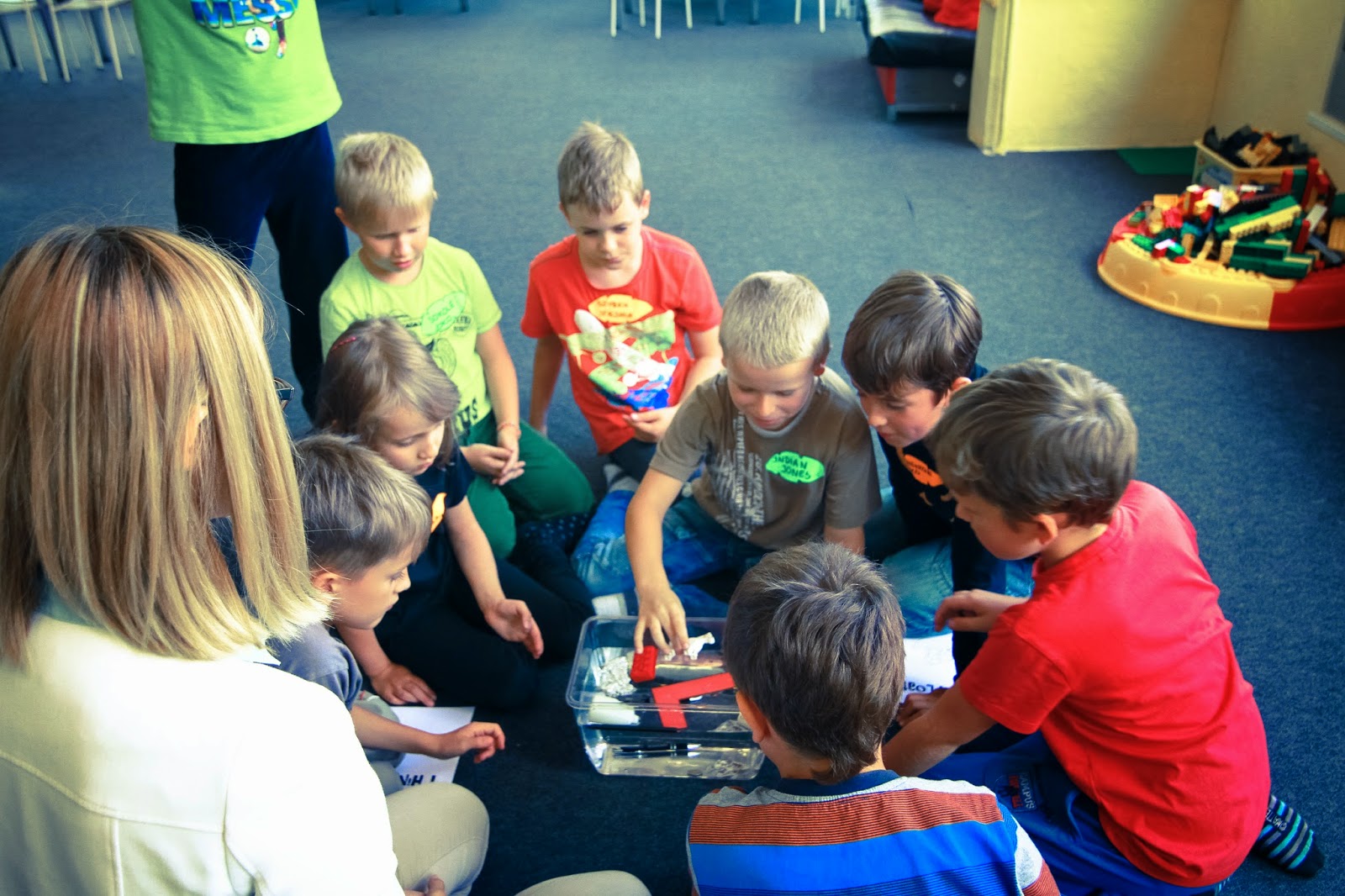
In our case this was a group of 9 children so we played all together. This task was the best ingredient of the lesson. Everyone had fun that you can see in the photos.
TASK 6 - Communication/Content
TIME: 10 mins
Ts can prepare an oral or written test based on the content presented during the lesson then ask Ss to do it at the lesson as a form of evaluation. The test to be checked together.
OR
Ts distribute the printouts from Science 2 by Macmillan and ask Ss to do the exercises. Group evaluation.
We have decided to do the other one and it hit the jackpot. This book was very helpful to gather all the information from the lesson.
Sometimes the best ideas come to your mind out of the blue. This time I got to know, that I was supposed to hold a lesson with over twenty students aged 12. Two groups of various English level, a typical school class. First, I had to find a common topic, then make up a lesson in about 2 hours. The course of events led me from a chart with some basic vocabulary straight to Zanzibar. How come? Let me explain.
The students were to learn about prefixes like SOME, ANY, NO and EVERY. I prepared a chart that they copied to their notebooks. I knew that that lesson was just a start of something bigger, so I didn't care about the fact they they will not accomplish the learning process. The lesson was aimed at indicating that there is such an element of English grammar and vocabulary. I had only 45 minutes, so the amount of time I could spend explaining grammar was also limited. What is more, during the lesson it was clear that most of the students knew the vocabulary perfectly. I just had to organise their knowledge.
After introducing words like "somebody, anybody, anywhere, nowhere, everything" etc. we moved to more exciting tasks. Task 1 - "Somebody to love"
I asked the students whether they had ever heard about the band Queen. I was not sure of the answer in the age of Justin Bieber but to my surprise and relief they could even elicit some titles of their hits! Amazing! Then, it was an easy job to encourage them to listen to the song, which is full of the words I wanted to revise.
Before listening to this piece of music, students were given the lyrics and their job was to underline all the words of the lesson and notice in what kinds of structure they are used (somebody for positive sentences, anybody for questions and so on). After analysing this part, we had a chance to enjoy the masterpiece. Task 2 - Mercury Rising
Then, I asked them what they knew about Freddie Mercury. After receiving some information on his biography, I handed out a reading task that comes from "Inside Out" by Macmillan. The text is not easy for students of primary school, but they managed to scan it and choose the right aswers in the quiz. Definitely, they succeeded in improving this exam technique which was one of the aims of the lesson.
Task 3 - Zanzibar
Well, I have to say that this lesson is an outcome of my fascination. With every moment of preparations I got more and more interested in Mercury's biography. The most shocking information for me was that he was born on this beautiful tropical island of Zanzibar. I decided to show my students how picturesque it is.
And that was the end of our lesson. Unfortunately, I have no chances to continue with the whole class, but the next thing my group is going to do is to deepen their understanding of the grammar topic itself. Maybe we will use the knowledge in some kinds of activities? I am waiting for an inspiration to come :)